REVIEW · TOURS
Balkan Tour
Albania opens the door to the Balkans. This private 14-day journey links four countries, mixing Ottoman towns, Greek and Roman ruins, Orthodox monasteries, mountain roads, and Adriatic beaches. I like the route’s variety, especially the shift from Butrint and Gjirokastra to Ohrid, Prizren, Kotor, and Budva. I also like having one driver-guide and an air-conditioned vehicle for a route where public transport would be slow and awkward.
The main trade-off is the pace. You cover a lot of ground, and several days involve long drives with short visits. At $3,820.09 per person, the price can make sense for a private trip with 13 nights, airport pickup, breakfasts, transport, and guiding, but you will still pay separately for food, drinks, and all fees and taxes.
In This Review
- Six things to know before booking
- Tirana begins with a gentle introduction
- Apollonia and Vlora connect antiquity with independence
- The Albanian Riviera is about the road as much as the stops
- Butrint, the Blue Eye, and stone-built Gjirokastra
- Berat shows Albania at its most architectural
- Elbasan and Ohrid shift the mood across the border
- Stobi and Skopje bring Roman roads and modern Macedonia
- Kosovo adds monasteries, bazaars, and a complicated present
- Montenegro finishes with mountains and the Adriatic
- Shkodra closes the loop in Albania
- What the $3,820.09 price really covers
- Who should book this Balkan route?
- FAQ
- How long is the Balkan Tour?
- Which countries does the tour visit?
- Where does the tour start?
- Is airport pickup included?
- Is this a private tour?
- What meals are included?
- Is transportation provided?
- Can I cancel for a full refund?
Six things to know before booking
- Four countries in one loop: The route travels through Albania, North Macedonia, Kosovo, and Montenegro, beginning and ending in Tirana.
- Private touring matters here: Only your group participates, so the driver-guide can shape the day around your pace more easily than a large coach tour.
- Ancient sites get serious attention: Apollonia, Butrint, Stobi, and the old centers of Berat, Ohrid, Gjirokastra, Prizren, and Kotor give the trip real substance.
- The scenery changes constantly: You move from the Ionian coast and Llogara National Park to Lake Ohrid, Kosovo’s mountains, and the Bay of Kotor.
- There are long road days: The route from Kosovo through Montenegro to Kolašin and Budva is especially demanding, though it rewards you with fine mountain views.
- The schedule includes free time: Saranda, Ohrid, and Budva each receive open periods, giving you some breathing room after guided sightseeing.
Tirana begins with a gentle introduction
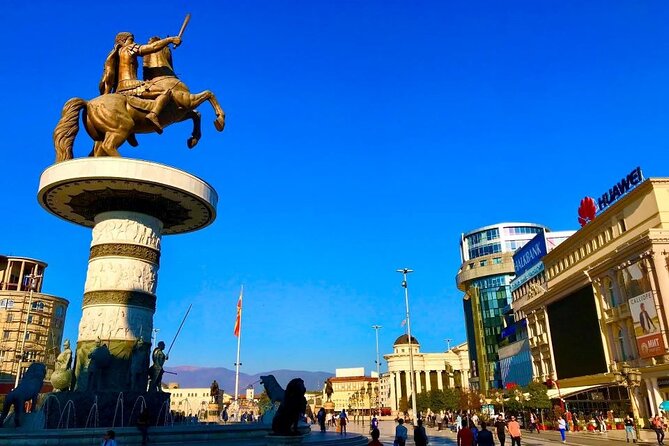
Your trip starts with pickup at Rinas Airport at 8:30 a.m., followed by a transfer into Tirana. The first visit takes about four hours and focuses on the compact city center, making it a sensible way to get your bearings without spending the first day on the road.
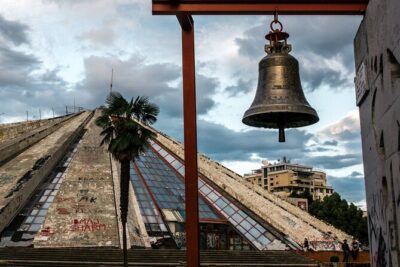
Scanderbeg Square is the natural starting point. The Clock Tower, built in the 1820s, is one of Tirana’s oldest constructions and a familiar city symbol. Nearby, the Et’hem Bey Mosque is noted for its detailed interior decoration and artwork. The National Historic Museum adds a useful sweep from ancient times through Albania’s communist period under Enver Hoxha.
I like this opening because it gives you political, religious, and urban context before the countryside begins. The visit is also free of admission charges according to the schedule, though the tour does not include all fees and taxes across the trip, so it is wise to confirm what is covered before setting out.
More trips out of Tirana:
- Hike Gamti Mountain with Bovilla lake view & canyon- From Tirana
★ 5.0 · 1,280 reviews - Berat city UNESCO tour, the Castle & Belshi lake- From Tirana
★ 5.0 · 804 reviews - Walking Tour of Tirana
★ 5.0 · 646 reviews
Apollonia and Vlora connect antiquity with independence
Day two heads west to Apollonia Archaeological Park, one of the major ancient centers along the Via Egnatia. The site was known as Apollonia Prima in honor of Apollo, and Augustus Octavian studied oratory here before becoming Rome’s first emperor. Those details help turn a pile of stones into a place with a clear role in the ancient world.
Allow three hours for Apollonia. You visit the ruins and an Orthodox monastery that now houses an archaeological museum. The stop is included, and its setting gives the morning a calm, open feel after the city sights of Tirana.
The afternoon belongs to Vlora, where Albanian independence was declared from the Ottoman Empire in 1912. The Museum of Independence gives that turning point a physical setting, while the visit to Zvernec Monastery adds a religious and scenic counterpoint.
You spend the night in Vlora. The day is well balanced, though the historical material at Apollonia and the independence story in Vlora both deserve more time than a quick glance. If your guide offers extra explanation, take it. These are the places where context makes the visit worthwhile.
The Albanian Riviera is about the road as much as the stops
Day three is one of the tour’s strongest scenic sections. The road follows the Albanian Riviera toward Saranda, passing traditional villages and climbing to Llogara National Park at roughly 1,100 meters. From there, you get wide views toward the Ionian Sea.
The scheduled stop lasts about two hours. It is a good place for photographs and fresh air, but remember that this is a road trip, not a hiking tour. No extended walk is specified, so do not pack the day with expectations of a long mountain trek.
Near Himara, you stop by the sea before visiting Ali Pasha Castle at Porto Palermo. The well-preserved fortress occupies a dramatic coastal position and gives the day a strong historic stop without requiring a full museum visit.
Saranda is the overnight base. In summer, it becomes Albania’s main Riviera resort, with a crowded seaside promenade, busy beaches, restaurants, and nightlife. I like the free afternoon here because it breaks up the sightseeing. The drawback is equally clear: summer crowds can make Saranda feel noisy and packed rather than peaceful.
Butrint, the Blue Eye, and stone-built Gjirokastra
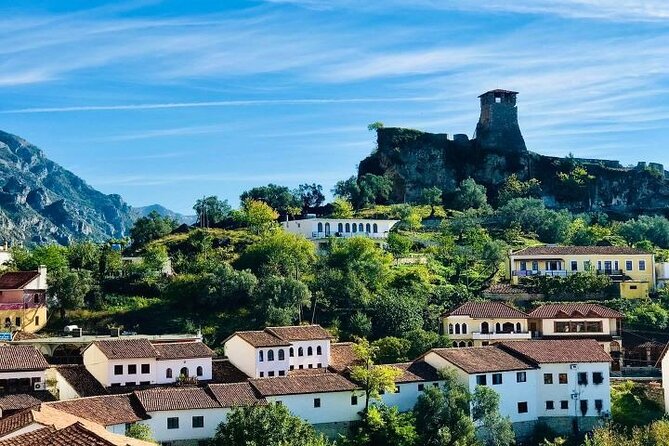
Day four brings the tour’s most memorable combination of ancient ruins and unusual natural scenery. Butrint National Park contains layers from prehistoric settlement, Greek colony, Roman city, Byzantine center, and Venetian occupation. The city was abandoned after marshes formed, and woods now surround many of the remains.
Three hours at Butrint is enough for a solid visit, but the site is extensive. Wear comfortable shoes and expect uneven ground. The admission is included, which helps at one of the route’s major archaeological stops.
Next comes the Blue Eye, a striking freshwater pool and source. The stop lasts about an hour. Its unusual color is the attraction, but the appeal also comes from the sudden change in scenery as the road crosses the hills toward Gjirokastra.
Gjirokastra is known as the Stone City and is a UNESCO World Heritage town. You visit the medieval bazaar, Ottoman-style houses, artisan workshops, the castle, and Skenduli House, built around 1700. The narrow cobbled streets and old guild shops give this part of the trip a more intimate feel than the larger coastal towns.
The castle is one of Albania’s major sights, while Skenduli House helps you see how a wealthy traditional home was arranged. The old town involves slopes and cobbles, so this is not the easiest afternoon for anyone who has trouble walking.
Something completely different:
- Kruja castle, the old Bazaar & Sarisalltik- Departure from Tirana
★ 5.0 · 592 reviews - Albanian Night Show: Traditional Music, Dance & Dinner in Tirana
★ 5.0 · 431 reviews - From Tirana- Hiking Tour to Bovilla Lake & Gamti Mountain
★ 5.0 · 358 reviews - Shala river & Komani lake -Day trip departure from Tirana/Shkodra
★ 5.0 · 309 reviews
Berat shows Albania at its most architectural
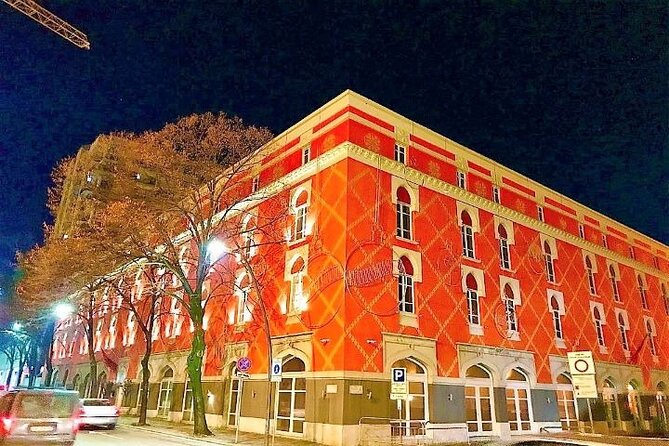
Day five is devoted to Berat, called the City of One Thousand Windows for its striking collection of Ottoman houses. The old city is divided into Mangalemi, Gorica, and Kala, the castle quarter above the town.
You begin in the castle area and visit the Onufri Museum of Iconography, housed in the Cathedral of St. Mary’s Assumption. The museum carries the name of the noted fresco and icon painter Onufri. The visit to the Red Mosque adds another layer to the town’s religious and architectural story.
The stop is scheduled for about six hours, making it one of the fuller sightseeing days. That is useful because Berat rewards slower looking. From the castle area, you can understand how the town developed on the hillsides rather than simply checking off another old quarter.
The main practical issue is the amount of walking on old stone surfaces. Bring shoes with a firm sole, and expect the day to feel more physical than the short descriptions of individual sights suggest.
Elbasan and Ohrid shift the mood across the border
Day six crosses from Albania toward North Macedonia. The stop at Elbasan focuses on the castle and takes about two hours. The road then continues through rural villages and open countryside to Struga on Lake Ohrid.
Struga is known for the point where the Black Drin River flows out of Lake Ohrid toward the Adriatic. The town is compact and easy to explore on foot. You can also walk about 15 minutes along the lake to Kalishta village and its cave monastery.
The day ends in Ohrid, with a free afternoon and overnight stay. That open time matters. After several road-heavy days, you can walk beside the lake or simply enjoy a slower evening without another formal visit.
Ohrid receives a full guided day on day seven. The program includes St. Sofia, St. Clement, Plaoshnik, St. John at Kaneo, Samuil Fortress, Saint Panteleimon, the Holy Virgin of Peribleptos, the Icon Gallery, and the old bazaar.
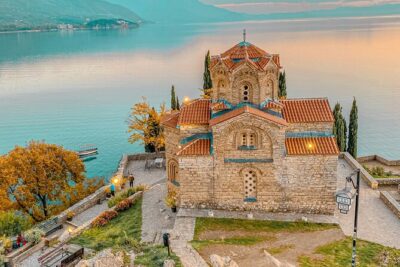
The churches are the heart of the visit. Plaoshnik is linked with St. Clement of Ohrid, who founded an important center of learning in the ninth century. St. John at Kaneo, on its small promontory above the lake, provides one of the route’s finest views.
Six hours gives you a meaningful look at Ohrid, though the number of churches can feel dense if religious art is not your main interest. The lake and old bazaar provide welcome variety.
Stobi and Skopje bring Roman roads and modern Macedonia
On day eight, you visit Stobi, one of North Macedonia’s key ancient sites. Its position in a fertile valley near the main north-south road made it an important trading center. The remains include a second-century amphitheater, the Theodosia Palace, early Christian ruins, and ornate mosaic floors.
The two-hour stop is included. Stobi is a good fit for anyone who enjoyed Apollonia and Butrint, though it is another open archaeological area where sun and uneven walking surfaces may affect your comfort.
Skopje follows, with a three-hour guided visit. The program includes the old Turkish bazaar, Mahmut Pasha Hammam, the Memorial House of Mother Teresa, the Stone Bridge, and Macedonia Plaza.
This pairing works because Stobi gives you the ancient setting while Skopje shows a capital shaped by Ottoman, modern, and national influences. The city has a mixed visual character, and the contrast is part of the experience rather than a flaw to hide.
Kosovo adds monasteries, bazaars, and a complicated present
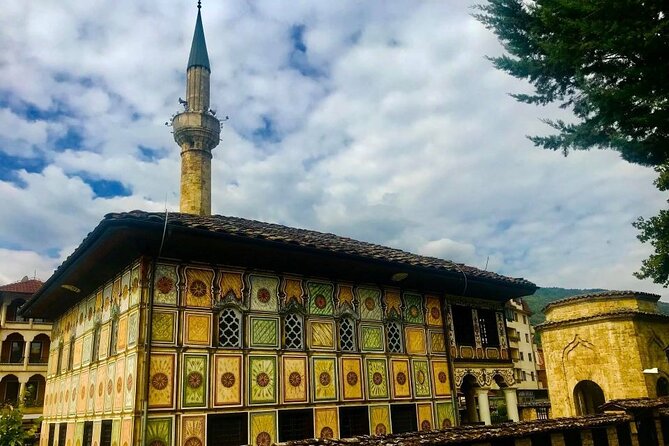
Day nine takes you to Kosovo, beginning with Gračanica Monastery near Pristina. The church was built on the ruins of an older thirteenth-century church, itself built over a sixth-century early Christian basilica. Only the church survives from the former monastic compound.
The monastery visit takes about two hours and is included. It is a particularly important stop for medieval religious art and architecture, but visitors should approach it with respect. This is a living religious site, not simply an archaeological display.
Pristina comes next. The capital is changing quickly, with traffic, mismatched buildings, museums, galleries, and a strong sense of a young country still finding its shape. The scheduled city visit lasts two hours, followed by an overnight stay.
I appreciate that the route does not pretend every capital is polished for tourists. Pristina’s value is its atmosphere and present-day energy, not a long list of grand monuments.
Day ten moves to Prizren, one of Kosovo’s most attractive historic towns. Its old architecture, Bistrica River, Sharr Mountain setting, and craft traditions make it feel more cohesive than Pristina. Gold and silver work are especially associated with local artisans.
The next stop is Visoki Dečani Monastery, built between 1327 and 1335 by the Serbian medieval king St. Stephen of Dečani. It lies in a valley along the Bistrica River, surrounded by mountains and forests. The visit lasts about an hour and is included.
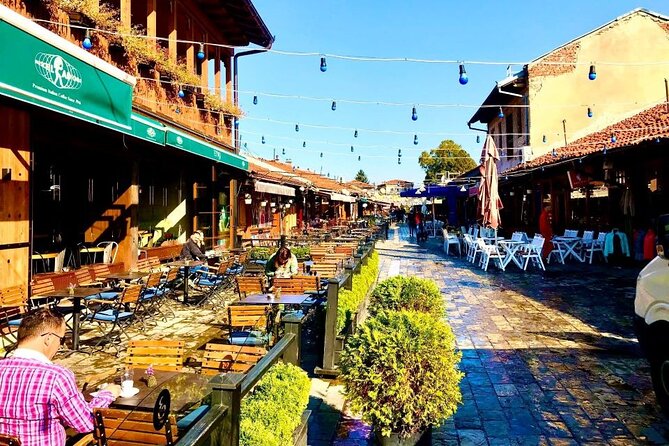
The day ends in Peja, Kosovo’s third-largest city. Its Turkish-style bazaar is worth seeing, while the town also serves as a base for the Rugova Valley and nearby mountain areas. The schedule gives you two hours here, so this is more an introduction than a full mountain outing.
Montenegro finishes with mountains and the Adriatic
Day eleven involves a long drive through northwestern Kosovo and Montenegro to Kolašin, Montenegro’s best-known ski resort. The stop itself is brief, about an hour, but the road journey is the main event.
Cetinje follows for two hours. The former capital sits in a green valley among rough gray mountains, with modest cottages beside old diplomatic mansions. Some of those grander buildings now serve as museums or art and music schools.
The final stop is Budva, Montenegro’s major coastal resort. Its old fortified headland is more than two millennia old, but modern hotels, yachts, restaurants, bars, and nightclubs now spread well beyond the walls. An island opposite the city is known for beaches, cold drinks, and seafood.
Budva is lively, not quiet. In summer, it can be crowded and loud. I like that the tour gives you a free afternoon on day twelve after visiting Kotor, but I would not choose Budva as a peaceful seaside retreat.
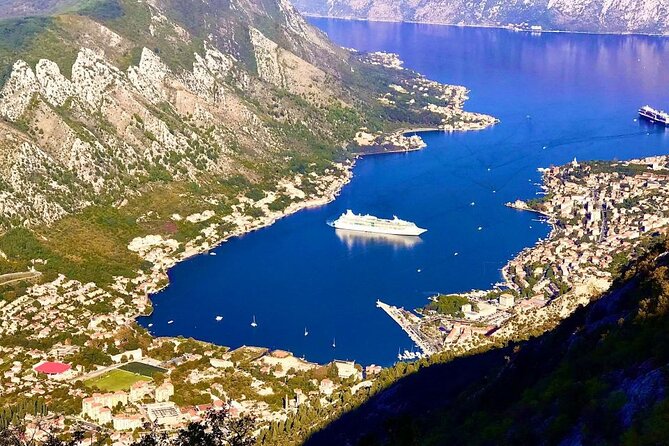
Kotor Old City is the centerpiece of that second day in Montenegro. Its medieval streets and buildings date from the twelfth through fourteenth centuries. The Bay of Kotor looks like a southern European fjord, though it is technically a submerged river valley, or ria, made up of four connected bays.
The two-hour visit offers a useful introduction to the old city, but Kotor is another place where a little independent wandering improves the experience. Afterward, you return to Budva for a free afternoon and overnight stay.
Shkodra closes the loop in Albania
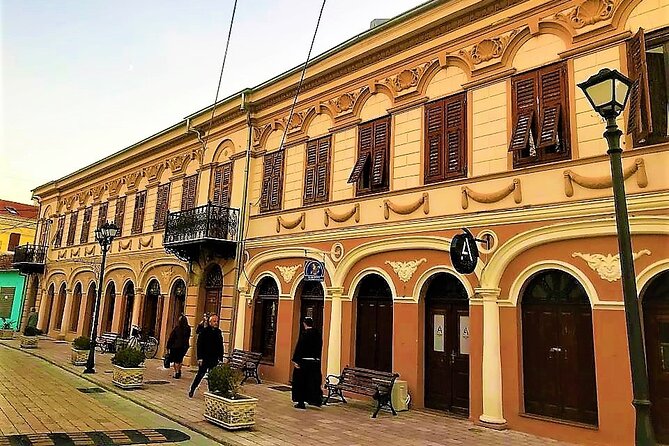
Day thirteen returns to Albania for Shkodra, an important center of Catholicism, culture, and religious cooperation. You visit the castle area, the Leaden Mosque, and a Catholic church before walking along Kole Idromeno Street, also known as Pedonalja.
The old center has a Mediterranean feel and brings mosques and churches into close view. You can also consider a stop at Lake Shkodra for swimming or a meal featuring krap ne tave, a local baked carp dish. The schedule mentions the Migjeni Theatre as another point of interest, though the exact time available will depend on the day’s driving.
The final night is not specified in the schedule, but day fourteen includes breakfast and an airport transfer from Tirana. The transfer is listed at about 30 minutes, though your actual timing will depend on traffic and the location of your hotel.
What the $3,820.09 price really covers
The cost includes 13 nights of accommodation, 13 breakfasts, an air-conditioned vehicle, a driver-guide, airport pickup, and airport transfer. It is a private trip, so you are not sharing the vehicle with a large mixed group.
That is the core value. Four countries, multiple border crossings, archaeological sites, and mountain roads would be difficult to arrange independently in 14 calendar days. A private driver also saves you from piecing together connections between places such as Gjirokastra, Ohrid, Prizren, and Kotor.
The price does not include food and drinks unless specifically stated, or all fees and taxes. You should ask for a clear breakdown of entrance charges before departure. Accommodation quality may vary, too. The arrangements can range from three-star to five-star properties, so confirm the expected standard if your hotel matters greatly.
The available feedback gives special credit to Alma at Albania Express Travel for handling bookings, itinerary planning, and arrangements with patience and care. That personal planning support is worth considering, especially if you want a private trip adjusted to your group rather than a fixed coach schedule.
Who should book this Balkan route?
I would choose this tour if you want a broad first look at the western Balkans and prefer someone else to handle the driving. It suits couples, families with adult children, and small private groups that value convenience and a guide’s help with a complicated route.
You should be comfortable with long road days, repeated hotel changes, uneven old-town streets, and sightseeing in hot or exposed archaeological areas. This is not the right choice if you want several days in one place, long hikes, or a relaxed beach holiday.
Book it for the range: Roman ruins in the morning, Ottoman streets in the afternoon, and an Adriatic town by evening. Skip it if you would rather explore fewer places at a slower pace. The free cancellation policy allows a full refund when you cancel at least 24 hours before the start time, which gives you some useful flexibility while making plans.
FAQ
How long is the Balkan Tour?
The trip lasts approximately 14 days and includes 13 nights of accommodation. The sightseeing schedule runs from day one through day fourteen.
Which countries does the tour visit?
The route travels through Albania, North Macedonia, Kosovo, and Montenegro.
Where does the tour start?
The tour starts at Rinas Airport in Tirana, Albania. The stated start time is 8:30 a.m.
Is airport pickup included?
Yes. Airport pickup and the transfer into Tirana are included. An airport transfer is also provided at the end of the trip.
Is this a private tour?
Yes. Only your group participates in the activity.
What meals are included?
Thirteen breakfasts are included. Food and drinks are not included unless specifically stated.
Is transportation provided?
Yes. The tour includes an air-conditioned vehicle and a driver-guide for the journey.
Can I cancel for a full refund?
You can receive a full refund if you cancel at least 24 hours before the experience start time. Cancellations or changes made less than 24 hours before the start are not refunded or accepted.
Just added in Tirana
- Wine Tasting day in Berat (Visit to the Berat Castle & Lunch included)★ 4.5 · 6 reviews
- From Tirana Wine Tasting & Food tour in Berat★ 5.0 · 5 reviews
- Bovilla and Kruja: Where History Meets Nature★ 5.0 · 2 reviews
- Visit Albania and Kosovo★ 5.0 · 2 reviews
- Visit Albania and Montenegro★ 5.0 · 1 review
- Virtual Reality Games and Experiences – Perfect place to drink and have fun!★ 5.0 · 2 reviews
- UNESCO heritage in Albania – 4 days★ 5.0 · 3 reviews
- Exclusive Qafshtama National Park Hiking Tour With Private Transfer★ 5.0 · 1 review
Tours, compared.
Berat city UNESCO tour, the Castle & Belshi lake- From Tirana
Read our review →
Berat Tour Osumi Canyons Exploration Lunch Transfer
Read our review →
Osumi Canyons and Bogova Waterfall from Berat – Tour by 1001 Albanian Adventures
Read our review →