REVIEW · TIRANA TOURS
Highlights of Albania
Albania packs empires, mountains, and sea into one week. This private eight-day journey links Tirana, Shkodra, Berat, the Riviera, Butrint, and Gjirokastra without asking you to arrange a new hotel or bus each morning. I like the strong mix of archaeological sites and everyday Albanian life, from Ottoman-era towns to a roadside pie stop. I also like the private guide format, which gives your group room to pause, ask questions, or make a useful detour.
The main consideration is pace. You cover much of the country in seven nights, so several days involve long drives and short visits. The price is $2,195.63 per person, with hotels, breakfast, private transport, and a driver-guide included, but lunches, dinners, and entrance fees are generally extra. That makes this a convenient introduction to Albania, though not a cheap independent-style holiday.
In This Review
- The Albania experience in six useful points
- Why this private Albania route works
- Day 1: Tirana from Skanderbeg Square to Bunk Art
- Day 2: Kruja, Lezha, and Shkodra’s northern views
- Day 3: Roman Durrës and the thousand windows of Berat
- Day 4: Ardenica, Apollonia, and Vlora’s independence story
- Day 5: The Riviera, Ali Pasha Castle, and Saranda
- Day 6: Butrint, the Blue Eye, and stone-roofed Gjirokastra
- Day 7: A local pie and a free afternoon in Tirana
- Transport, hotels, meals, and the real cost
- Who should choose this eight-day tour?
- Should you book Highlights of Albania?
- FAQ
- How long is the Highlights of Albania tour?
- Where does the tour begin?
- Is airport pickup included?
- Which UNESCO World Heritage Sites are included?
- Are meals included?
- Is this a private tour?
- Can I cancel for a full refund?
The Albania experience in six useful points
- Three UNESCO World Heritage Sites: You visit Berat, Butrint, and Gjirokastra, each showing a different side of Albania.
- A private car and guide: Air-conditioned transport replaces the uncertainty of arranging intercity travel yourself.
- Skanderbeg country: Kruja, Lezha, Tirana, and Ardenica connect the tour to Albania’s national hero.
- A well-rounded route: The program combines Roman ruins, mountain views, Ionian beaches, communist-era sites, and traditional towns.
- Seven hotel nights with breakfast: Your accommodation is arranged in Tirana, Shkodra, Berat, Vlora, Saranda, Gjirokastra, and Tirana again.
- A guide can shape the trip: Adam is repeatedly praised for his warmth, local knowledge, flexibility, and willingness to make personal stops.
Why this private Albania route works
Albania is compact on a map, but its mountain roads and scattered sights make planning harder than it first appears. This tour solves that problem with a driver-guide and one continuous route. You are picked up at Rinas Airport in Tirana, then travel in an air-conditioned vehicle for the rest of the week.
The private setup matters. You are not tied to the rhythm of a large coach group, and the guide can explain details as you go rather than leaving you to decode every castle and ruin alone. The strongest praise has centered on Adam, who has been singled out for answering questions, explaining the geology of the country, and even helping locate land connected with a visitor’s parents.
The tour also includes some thoughtful local touches. One example is the stop for Albanian pie on the return to Tirana. At about 50 lek per piece, or roughly 35 cents as described, it is a simple way to try a fast food enjoyed across the country rather than another international chain.
Still, this is a survey tour, not a slow stay in each town. You often get one to three hours at a stop, enough for the main sight and a short walk, but not enough for every museum, café, and side street. If you want long beach afternoons or unhurried photography, you will need extra nights before or after the program.
More trips out of Tirana:
- Hike Gamti Mountain with Bovilla lake view & canyon- From Tirana
★ 5.0 · 1,280 reviews - Berat city UNESCO tour, the Castle & Belshi lake- From Tirana
★ 5.0 · 804 reviews - Walking Tour of Tirana
★ 5.0 · 646 reviews
Day 1: Tirana from Skanderbeg Square to Bunk Art
Your guide meets you at the airport and takes you to the Tirana hotel. After a short break, the city tour begins with Skanderbeg Square, the large central plaza described in the program as the largest square in Europe.
The square brings several key sights together. You see the monument to national hero Gjergj Kastrioti Skanderbeg, the Et’hem Bey Mosque, the Opera House, and the Clock Tower. This is a useful first lesson in Albania’s past because Ottoman, royal, communist, and modern national symbols all sit close together.
The route continues to the Pyramid, a striking former communist monument, then to Bunk Art, where the country’s communist period receives more direct attention. Government buildings, the main boulevard, and Mother Teresa Square round out the four-hour visit.
I like this opening because it gives context before the countryside begins. Tirana is not presented as a polished old European capital. It is a city changing quickly, with traces of Ottoman rule, communist isolation, and present-day redevelopment sharing the same streets.
The first day is fairly short, which helps after a flight. You should still expect a busy introduction rather than a full museum day. Your evening is in Tirana, so you have some time to eat independently and rest.
Day 2: Kruja, Lezha, and Shkodra’s northern views
The second morning starts with Kruja, a hill town at about 608 meters above sea level. The castle and elevated position give you wide views, while the town’s importance comes from Skanderbeg’s 25-year resistance against the Ottoman advance in the fifteenth century.
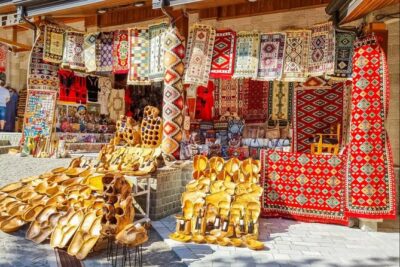
Inside the castle walls, the Gjergj Kastrioti Skanderbeg Museum presents that national story. The site also includes the Ethnographic Museum and Dollma Tekke. Near the entrance, the old bazaar sells embroidered goods, carpets, silver, copper, alabaster, filigree, traditional clothes, and antiques.
Allow time to browse rather than treating the bazaar as a quick photo stop. It is one of the better places on the route to look for a small Albanian craft item. The two-hour visit is enough for the principal sights, though shoppers may wish for longer.
Lezha follows, with a one-hour stop tied to another important chapter of Albanian history. The city was known in antiquity as Lissus, and in 1444 Albanian principalities joined there in the League of Lezha to resist the Ottomans. The memorial tomb of Skanderbeg was built over the ruins of Saint Nicholas Cathedral and displays 25 shields symbolizing his army’s victories.
By afternoon, you reach Shkodra, one of northern Albania’s key cities and an ancient Illyrian center. Rozafa Castle is the main attraction. From its high position, you get broad views over the surrounding area and a clear sense of why the site mattered militarily.
The city walk shifts the mood. The renovated pedestrian area has Italian and Austrian architectural links, reflecting Shkodra’s long contact with both countries. The visit to a Viennese mask factory adds a craft element that many history-heavy itineraries lack. The masks are made by hand and decorated with bright colors, feathers, gold leaf, and crystals.
You spend the night in Shkodra. This is a full day with three stops, so keep your footwear practical and expect some time in the vehicle.
Day 3: Roman Durrës and the thousand windows of Berat
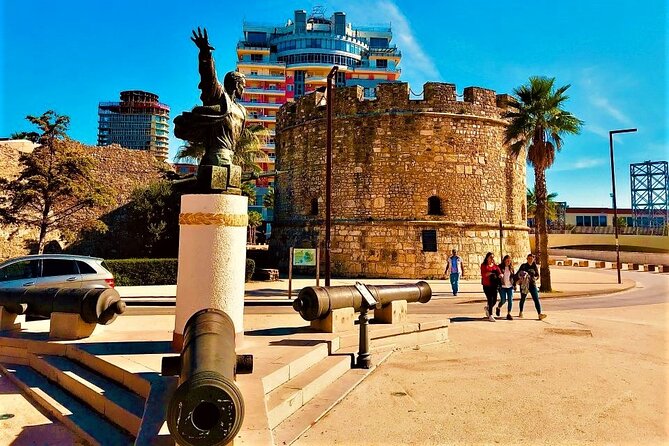
Durrës offers a strong ancient-world stop before the route turns inland. The city has almost 3,000 years of history and remains Albania’s largest seaport. Its Roman amphitheater, built for about 15,000 people, is the main sight and is described as the second-largest amphitheater in the Balkans.
Nearby, you can see a small early church with mosaics, second-century bathhouses, a Byzantine forum with marble columns, and part of the old city wall. The archaeological museum is another possible stop, although the program does not specify an included admission or a fixed museum visit.
Three hours gives you time to see the main remains without turning Durrës into an entire day. The setting is more urban than Butrint or Apollonia, so the appeal is primarily archaeology and city history rather than scenery.
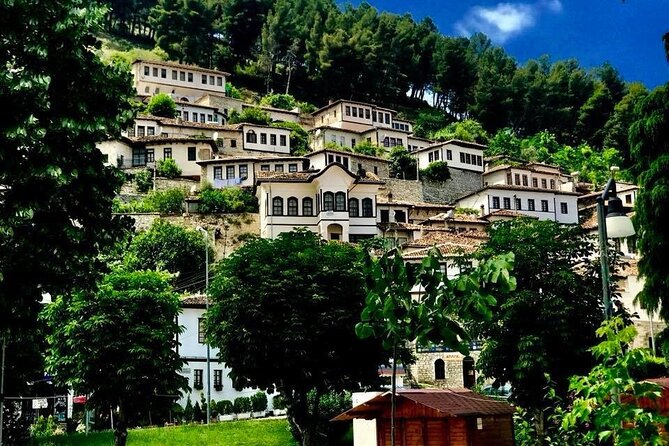
In the afternoon, Berat changes the tone completely. Known as the city of a thousand windows, it has been a UNESCO World Heritage Site since 2005. The white Ottoman-era houses of the Mangalem quarter rise up the slope, creating the view that gives Berat its nickname.
Berat Castle is still lived in, which makes it more than a preserved monument. Inside, you visit the Cathedral of Saint Mary and its icon museum, with more than 100 works connected to Onufri, his son Nikolla, Joan Çetiri, Onufër Qiprioti, and unnamed painters.
The program also includes the old town, the Gorica Bridge, the King Mosque, the Halveti Tekke, and Mangalem. Three hours is enough to sample these highlights, but the castle’s uphill paths and old stone surfaces may be tiring. Take care on uneven ground.
Berat is one of the tour’s best overnights because the town has a distinct character and deserves a slower evening. Breakfast is included the next morning.
Something completely different:
- Kruja castle, the old Bazaar & Sarisalltik- Departure from Tirana
★ 5.0 · 592 reviews - Albanian Night Show: Traditional Music, Dance & Dinner in Tirana
★ 5.0 · 431 reviews - From Tirana- Hiking Tour to Bovilla Lake & Gamti Mountain
★ 5.0 · 358 reviews - Shala river & Komani lake -Day trip departure from Tirana/Shkodra
★ 5.0 · 309 reviews
Day 4: Ardenica, Apollonia, and Vlora’s independence story
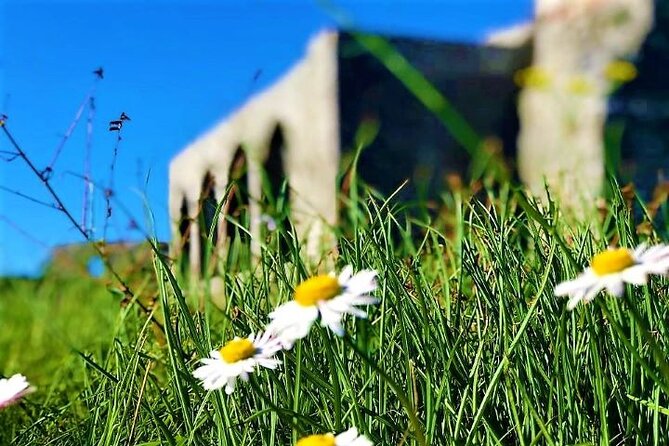
Ardenica Monastery sits at about 237 meters above sea level and gives the day an unusual opening. The site is linked to an earlier pagan temple dedicated to Artemis, while the present monastery complex covers about 2,500 square meters.
Its strongest historical association is Skanderbeg’s wedding to Donika in April 1451. St. Mary’s Church is the main building, made partly with stones from ancient Apollonia. Inside, frescoes add color and detail to the visit. Admission is included here.
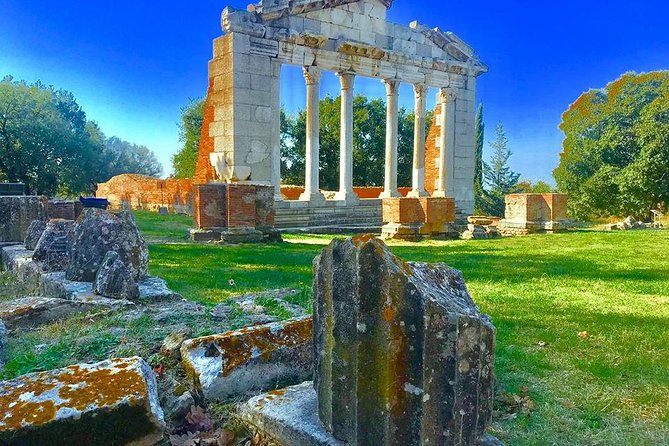
Next comes Apollonia Archaeological Park, an ancient city founded by Greek colonists on land associated with the Taulantii Illyrian tribe. Its importance grew as a commercial center, and the site now combines ruins, monuments, and open countryside.
I like the pairing of Ardenica and Apollonia because the two stops show how many layers Albania has. One is a religious site with medieval and national associations. The other reaches back to Greek and Illyrian settlement and later classical urban life.
The two-hour Apollonia visit is enough to understand the site, though the exposed setting means sun protection is sensible in warm months. The tour includes admission here as well.
By afternoon, you arrive in Vlora, the coastal city where Albanian independence was declared from the Ottoman Empire in 1912. The Museum of Independence gives that event a physical place in the national story. You also visit Zvernec Monastery before spending the night in Vlora.
Day 5: The Riviera, Ali Pasha Castle, and Saranda
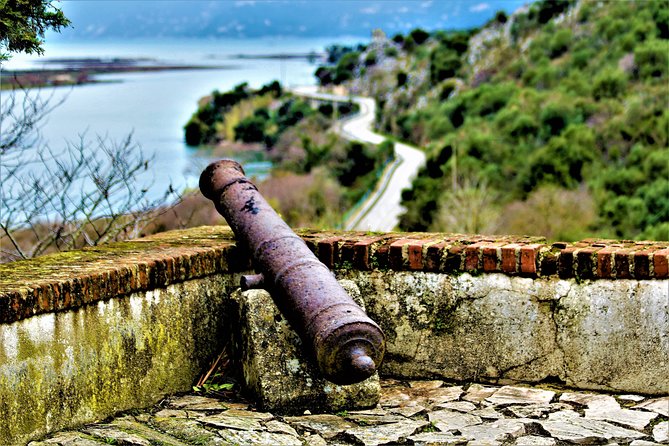
The route now turns to the Albanian Riviera. The first stop is Ali Pasha Castle, built in 1814 on a hill by an island and linked to the shore by a narrow artificial causeway. Its triangular form and three corner bastions make it easy to recognize from a distance.
The castle is associated with Ali Pasha Tepelena, who ordered it after an earlier Byzantine fortress was destroyed. The church of St. Nicholas was built across from it during the same period. Admission is included, and one hour is enough for a compact visit and the main views.
Borsh gives you two hours along one of the country’s best-known coastal stretches. The program emphasizes the rugged shore, traditional villages, isolated bays, and golden beaches. The coast has changed as more people have discovered it, but the route still gives you a useful look at the meeting point of the Adriatic and Ionian seas.
Do not treat this as a dedicated beach holiday. The timing allows for a taste of the coast, not a full day beside the water. If swimming and beach time are your main goals, extending your stay in the south would make sense.
Saranda is the final stop. This is the unofficial center of the Riviera, with beaches, nightlife, archaeological sites, and nearby natural attractions. The itinerary includes Pasqyra Beach, described as a sheltered bay that remains relatively quiet even in high season, and Lekursi Castle above the town.
The stop also touches on the Jewish history of southern Albania. During the Second World War, Albania provided safety for Jewish families fleeing persecution, a notable part of the country’s modern story. You spend the night in Saranda.
Day 6: Butrint, the Blue Eye, and stone-roofed Gjirokastra
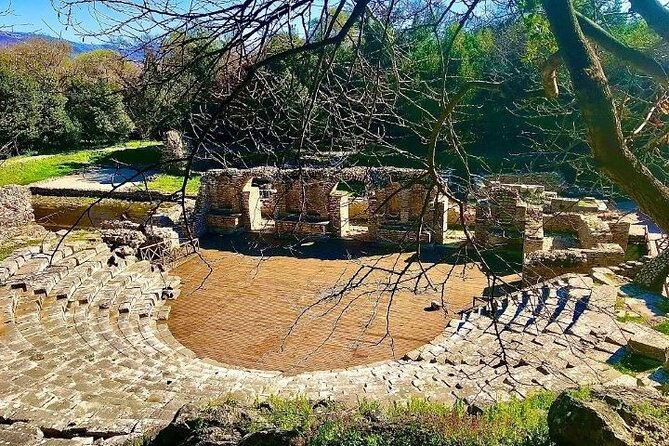
Butrint is the tour’s major archaeological visit. It was the first Albanian site added to the UNESCO World Heritage list, in 1992, and has been occupied from prehistoric times through Greek, Roman, Byzantine, and later periods.
The ruins include a theater, religious buildings, city structures, and inscriptions in Greek and Latin. Finds connected with the site include statues and portrait heads associated with Apollo, Zeus, Agrippina, and Livia. The three-hour visit gives you time to follow the main archaeological route, though the size of the park makes comfortable shoes a good idea.
The site’s appeal is not only the ruins. Butrint combines ancient stonework with trees and open surroundings, giving the visit a calmer feel than Durrës. Admission is included.
After Butrint, the drive continues toward Gjirokastra with a stop at the Blue Eye. This natural spring produces intensely blue and turquoise water, viewed from a small metal balcony. Swimming is prohibited by signs, though people sometimes ignore them, and the water is notably cold.
The one-hour stop is brief and focused. You see the spring, take photographs, and continue rather than spending half a day at the site.
Gjirokastra is another UNESCO World Heritage city, built on steep slopes with stone-roofed houses stacked above one another. Its paved streets, traditional homes, mountain views, and large castle give it a strong sense of place.
The city is also tied to writer Ismail Kadare and former communist leader Enver Hoxha, whose childhood home is among the sights. Two hours lets you walk through the old quarter and understand the city’s form, but the steep streets can be demanding.
Gjirokastra is a fine overnight choice. The program points to local food as part of the experience, although meals are not included in the tour price.
Day 7: A local pie and a free afternoon in Tirana
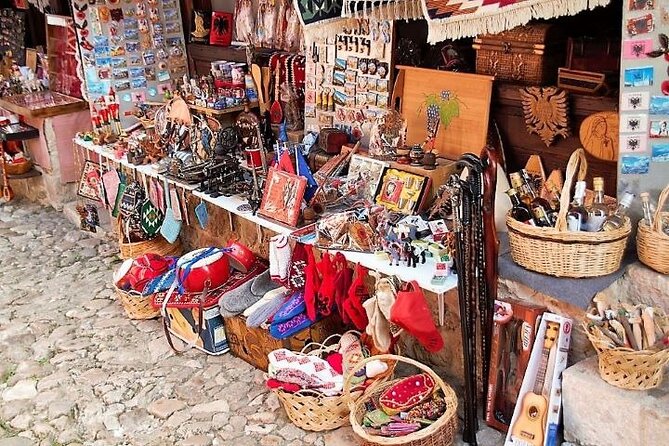
After breakfast, you return to Tirana. The pie stop is a small but welcome break from formal sightseeing. Albanian pie comes in different forms and flavors, and the selected fast-food shop is presented as a particularly local choice.
The afternoon is free in Tirana. That gives you a chance to return to a museum, walk the boulevard, revisit the central square, or simply sit at a café. It also softens the pace after several days of castles and ruins.
The schedule lists about three hours for this part of the day, though the main value is the unstructured time afterward. Since the tour begins and ends in Tirana, you do not need to solve a separate transfer back to the airport.
Transport, hotels, meals, and the real cost
The $2,195.63 price buys seven nights of accommodation, breakfast, an air-conditioned vehicle, and a driver-guide. It also covers a private arrangement for your own group rather than a shared coach.
That package can be good value if you would otherwise hire cars, book several hotels, arrange airport transfers, and pay for a local guide at major sites. Albania’s roads and changing distances make the convenience meaningful. Several past clients praised the hotels as better than expected, along with the organization from airport pickup to final drop-off.
The price does not include lunches, dinners, or all fees and taxes. Some admissions are specifically included, such as Ardenica, Apollonia, Ali Pasha Castle, Butrint, and the Blue Eye, while other entries may cost extra. Ask for a current list of included entrance fees before booking so your daily budget is clear.
Food is another part of the value calculation. Breakfast is supplied, but you pay for other meals. This gives you freedom to choose restaurants and try local dishes, though it also means the headline price is not the final amount you will spend.
The booking contact Alma has been praised for quick replies and clear communication. Adam has received the strongest personal praise as a guide, but you should confirm who will lead your particular departure.
Free cancellation is available up to 24 hours before the start time for a full refund. Changes made inside that window are not accepted, and the departure requires a minimum number of participants.
Who should choose this eight-day tour?
I would recommend it to someone visiting Albania for the first time who wants the major cultural stops without handling the logistics. It suits couples, families, and small private groups, and the information supplied says most people can participate.
It is especially good for you if you want:
- Ancient Greek, Roman, Byzantine, Ottoman, and communist-era sites in one route
- A private guide rather than a large group
- Hotels and breakfast arranged in advance
- Coastal scenery without giving up inland history
- The flexibility to ask for personal stops or local food suggestions
I would hesitate if you want a slow beach break, long museum visits, or several nights in one place. The route is ambitious, and some stops are necessarily introductory.
Should you book Highlights of Albania?
Book it if your priority is seeing a lot of Albania in one organized week. The route is unusually broad for eight days, and the combination of private transport, breakfast, hotel bookings, and a local guide removes much of the work.
Before paying, confirm the exact hotels, guide name, entrance fees, and how much free time you will have in each town. If you accept a quick-moving schedule, this is a strong first look at Albania, with real variety and several memorable stops. If you want the coast above all else, use this tour as a framework and add extra nights in Saranda or Vlora.
FAQ
How long is the Highlights of Albania tour?
The tour lasts approximately eight days and includes seven nights of accommodation.
Where does the tour begin?
It begins at Rinas Airport in Tirana, Albania. The listed start time is 8:30 am.
Is airport pickup included?
Yes. The guide meets you at the airport on the first day, and the final day includes transport to the airport.
Which UNESCO World Heritage Sites are included?
The route visits Berat, Butrint National Park, and Gjirokastra. These are the three UNESCO World Heritage Sites included in the program.
Are meals included?
Breakfast is included with the accommodation. Lunches and dinners are not included.
Is this a private tour?
Yes. Only your group participates, and the tour uses a private driver-guide and air-conditioned vehicle.
Can I cancel for a full refund?
You can cancel at least 24 hours before the experience start time for a full refund. Cancellations made less than 24 hours before the start time are not refunded.
Just added in Tirana
- Wine Tasting day in Berat (Visit to the Berat Castle & Lunch included)★ 4.5 · 6 reviews
- From Tirana Wine Tasting & Food tour in Berat★ 5.0 · 5 reviews
- Visit Albania and Kosovo★ 5.0 · 2 reviews
- Bovilla and Kruja: Where History Meets Nature★ 5.0 · 2 reviews
- Visit Albania and Montenegro★ 5.0 · 1 review
- Virtual Reality Games and Experiences – Perfect place to drink and have fun!★ 5.0 · 2 reviews
- UNESCO heritage in Albania – 4 days★ 5.0 · 3 reviews
- Exclusive Qafshtama National Park Hiking Tour With Private Transfer★ 5.0 · 1 review
Tirana Tours, compared.
Hike Gamti Mountain with Bovilla lake view & canyon- From Tirana
Read our review →
Berat city UNESCO tour, the Castle & Belshi lake- From Tirana
Read our review →
Kruja castle, the old Bazaar & Sarisalltik- Departure from Tirana
Read our review →
Albanian Night Show: Traditional Music, Dance & Dinner in Tirana
Read our review →
Shala river & Komani lake -Day trip departure from Tirana/Shkodra
Read our review →