
REVIEW · DURRES TOURS
Private Walking Tour Visit to Durrës with Licensed Guide
Durrës reveals its layers quickly. This private walking tour links Roman ruins, Ottoman buildings, churches, mosques, Italian-era architecture, and communist-era changes in one compact route. I like the personal format, and I like that the guide uses old maps, photographs, and surviving buildings to explain how the city changed.
At $24.10 per person, the tour offers strong value if you want context rather than a quick look at monuments. The main consideration is pace: with 14 stops in about two to three hours, several visits last only 10 minutes, so this is best for orientation and interpretation, not long interior visits.
In This Review
- Five details that make this Durrës walk worthwhile
- Why this private Durrës walk works so well
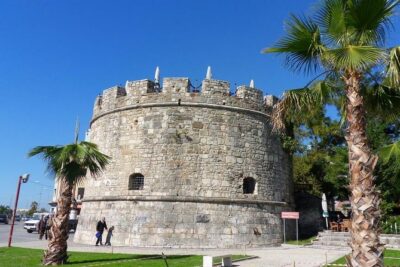
- Starting at the Venetian Tower
- Saints, churches, and a former Ottoman bath
- Bulevardi Epidamn and a taste of local life
- Aleksandër Moisiu and the marks of the 2019 earthquake
- Fatih Mosque and the city’s Ottoman foundations
- The amphitheater and the problem of a city built above its past
- Saint Lucy and the return of religious life
- Freedom Square and the civic center
- The Palace of Culture and the Byzantine Forum
- How much value do you get for $24.10?
- Who should book this walk?
- Should you book the Durrës walking tour?
- FAQ
- Where does the tour begin?
- Where does the tour end?
- How long does the walking tour last?
- What language is offered?
- How much does the tour cost?
- Is this a private tour?
- Is admission to the Venetian Tower included?
- Are refreshments included?
- Is the tour near public transportation?
- Can I cancel for a full refund?
Five details that make this Durrës walk worthwhile
- Roman to modern Durrës in one route: You move from the second-century amphitheater and Byzantine walls to Italian-era buildings, communist changes, and today’s urban transition.
- A truly private experience: Only your group takes part, allowing the guide to shape explanations around your interests.
- Old maps and photographs add context: These help you picture streets, buildings, and neighborhoods that no longer look as they once did.
- Small local refreshments are included in the walk: Along Bulevardi Epidamn, the guide pauses at two or three local spots for coffee, water, burek, ice cream, or orange juice.
- Artan and Joana receive especially warm praise: Artan is described as deeply attached to Durrës, while Joana is praised for clear and capable explanations.
Why this private Durrës walk works so well
Durrës is easy to underestimate. Many people see it as Albania’s beach city, but its center contains layers from Greek and Roman times through Byzantine, Ottoman, Italian, communist, and modern periods. The strength of this tour is its broad frame. You are not simply shown an amphitheater and sent on your way. You are helped to understand how each period altered the city around it.
The walk begins at the Venetian Tower of Durrës and ends at Sheshi Liria, also called Freedom Square. The route is central, and the end point leaves you in a useful part of town, with access to different directions from the main city center.
The tour is offered in English, uses a mobile ticket, and normally lasts about two to three hours. Since it is private, only your group participates. That matters here because Durrës has many fragments rather than one perfectly preserved historic quarter. A good guide needs time to connect those fragments, and a private format makes it easier to ask why a wall, mosque, square, or damaged house matters.
More Walking Tours in Tirana
- Walking Tour of Tirana
★ 5.0 · 646 reviews - Local food experience & walking tour of Tirana
★ 5.0 · 192 reviews - Berat Walking Tour
★ 5.0 · 86 reviews
Starting at the Venetian Tower
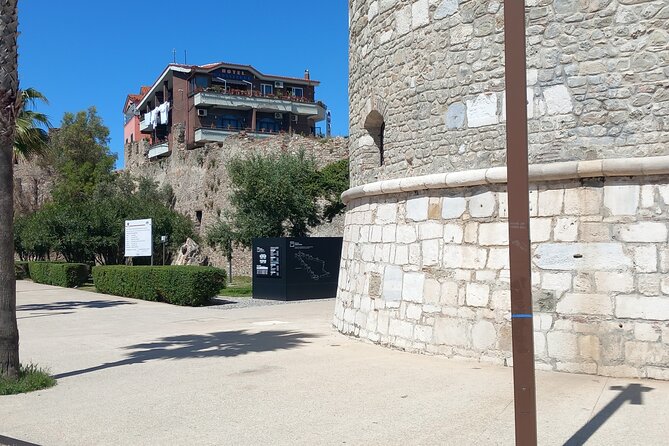
The Venetian Tower is the first major reference point. The opening discussion places Durrës in its wider urban setting, using old maps, photographs, and locations to show the effects of different cultures, nations, and religions.
You will hear about the second-century amphitheater, Byzantine, Norman, Venetian, and Ottoman defenses, as well as the planning and architecture of the industrial period. The guide also explains the city’s current changes, so the opening is not trapped in ancient history. It gives you a way to read Durrës as a living city.
The tower itself receives a second, more focused stop. You learn about its construction, building methods, and similarities to towers around the Adriatic and other coastal areas. Its story continues through Ottoman rule, demilitarization during the early years of World War II, the communist period, and the last three decades.
Entrance to the interior is included. The multimedia projection and raised balcony require an extra payment, however. That small cost is worth knowing before you arrive, especially if you want the full tower experience. The tour still works without those additions, but the extra view and presentation may appeal to anyone who enjoys visual displays.
Saints, churches, and a former Ottoman bath
The Church of Apostle Paul and Saint Asti gives the walk a quieter pause. Here, the guide explains the two saints’ connection with Durrës and points out traces of the former Church of Saint Spiridon, which was demolished during the communist period.
That detail is important because the religious story of Durrës is not only about buildings still in use. It is also about absences. A missing church can tell you as much about the communist period as a surviving one tells you about earlier centuries.
The medieval bath, or hammam, brings the Ottoman period into view. Built in the seventeenth century, it may have been privately owned or connected with government buildings along the seaside promenade. It may also have been associated with the White Mosque, which once stood just west of it.
The remaining traces help you identify the former road leading to Durrës Castle. You will also hear how steam and heating worked in the building. Do not expect a grand, fully restored bathhouse. This stop is about reading partial remains and understanding their original function.
Bulevardi Epidamn and a taste of local life
Bulevardi Epidamn shifts the focus from ruins to urban growth. The guide explains how the first urban regulatory plan of 1928 shaped early residential investment along this road.
This is one of the more practical parts of the walk because it helps you notice the city’s ordinary buildings, not just its official monuments. Residential architecture can reveal how Durrës expanded, who invested in it, and how planning changed after the Ottoman period.
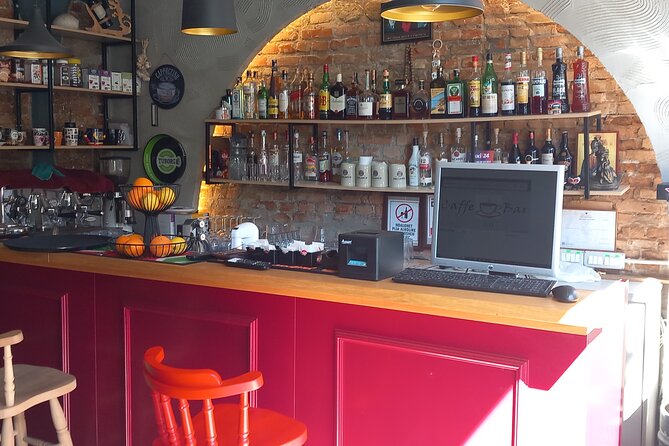
The guide pauses at two or three local spots for refreshments. Options include coffee, water, burek, ice cream, or orange juice. The information does not specify that these refreshments are included in the $24.10 price, so you should be prepared to pay for anything you choose. Still, the pause adds a welcome local touch and breaks up the steady sequence of historical stops.
More of Durres:
- Berat-Durres and Belsh Lake, day tour from Tirana
★ 4.5 · 274 reviews - Durres: Off Road ATV Kallmi Tour
★ 4.5 · 51 reviews - Kruja & Durres; Semi – Private Day Tour from Tirana
★ 5.0 · 33 reviews - Kruja Castle ,Sari Salltik & Durrës fromTirana
★ 4.5 · 30 reviews
Aleksandër Moisiu and the marks of the 2019 earthquake
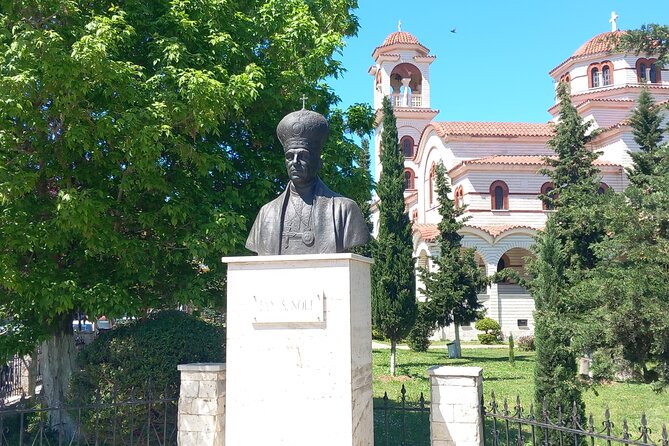
The Aleksandër Moisiu Museum introduces traditional Albanian and Durrës architecture. The house once served as the English consulate when Durrës was the capital after national independence. It is also linked with Aleksandër Moisiu, one of the city’s best-known international theater artists.
The building is awaiting needed investment after damage from the 2019 earthquake. The Byzantine tower beside it was also damaged. That unfinished condition is part of what you encounter. It reminds you that historic preservation is an active problem, not a task completed long ago.
This stop suits anyone who wants a more human connection to the city. Aleksandër Moisiu’s career links Durrës with the wider theater world, while the house itself connects diplomacy, architecture, and local history.
Fatih Mosque and the city’s Ottoman foundations
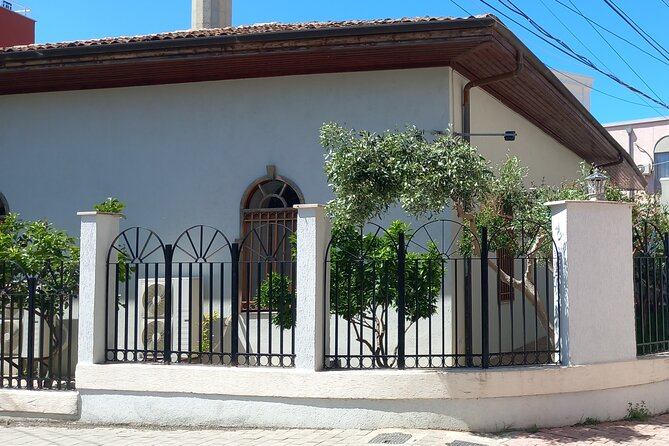
Fatih Mosque is one of Albania’s three oldest mosques. Built in 1501, it sits at the base of the Byzantine wall between two outer towers.
The placement is not accidental. The towers helped shield the minaret from the sea and from possible attacks. The mosque also uses building materials connected with the Byzantine walls, with supporting sections of the older wall helping form the broad base of the structure.
This is a good example of how Durrës reused its past instead of clearing it away. You can see different periods sharing the same space. The stop is short, so you will receive the main historical explanation rather than an extended architectural study.
The amphitheater and the problem of a city built above its past
Durrës’s amphitheater is the tour’s major Roman site. The guide explains its history and, just as importantly, the way modern Durrës grew over and around it.
The amphitheater was excavated in 1966 by archaeologist Vangjel Toci. That discovery exposed an important part of the ancient city and raised a difficult question: how do you protect major archaeological remains inside a modern urban center?
You will hear about the government project intended to restore the entire amphitheater and preserve its many historical layers. The stop is not simply about Roman entertainment. It is also about excavation, planning, restoration, and the tension between daily city life and ancient remains.
The scheduled time is about 10 minutes, which is enough for an introduction but not enough for an unhurried examination of every feature. If you want to spend longer at the amphitheater, plan to ask the guide how much flexibility the private format allows.
Saint Lucy and the return of religious life
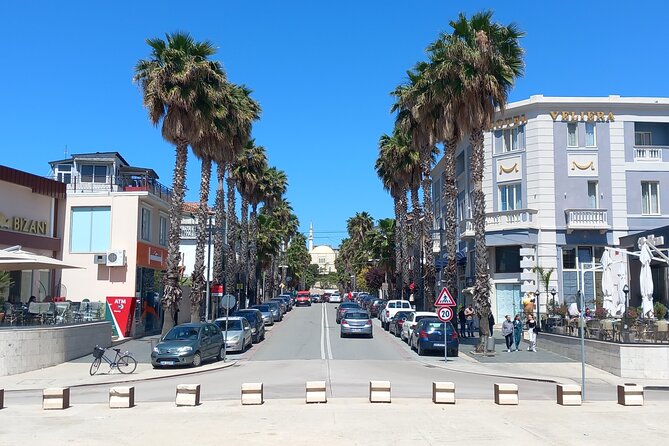
The Catholic Church of Saint Lucy sits along the winding streets of Durrës. The guide covers its construction, important figures in city government, and the church’s spiritual role.
You will also compare its present condition with its past, especially the communist period when religious activity was legally banned. That makes this stop part of the larger story of religious suppression and return in Albania.
The tour later visits the Grand Mosque, built in 1939 with investment from local merchants during Italy’s economic dominance before World War II. Under communism, it was closed and altered. After the 1990s, it was restored and returned to religious use.
Taken together, these religious sites show how Durrës changed under Ottoman rule, Italian influence, communist control, and post-1990 recovery. The buildings are not isolated attractions. They help explain the city’s social changes.
Freedom Square and the civic center
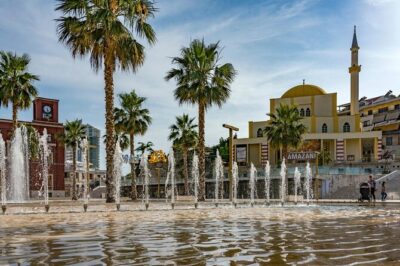
Freedom Square was first planned as a floral garden in the 1928 urban regulatory plan. Today it contains the Municipality and the Grand Mosque, making it a natural place to discuss Durrës’s civic center.
The guide follows the square from the Ottoman era through the years before World War II and into the present. You will see how the city expanded outward into neighborhoods once known as Varosh.
Durrës City Hall, built in 1931, reflects the Italian architectural taste of the period. Its large central balcony was designed for public speeches in the square. After the 1926 earthquake destroyed the clock tower, a public clock was placed on the new City Hall.
This kind of detail gives the square a public, political character. You are not just looking at a handsome building. You are hearing how the city displayed authority, marked time, and addressed its population.
The Palace of Culture and the Byzantine Forum
The Palace of Culture, named for Aleksandër Moisiu, dates from 1960. It was the first building of its type in the Republic of Albania.
The guide uses it to explain Albanian architecture of the 1960s and its influence across the country. For anyone interested in communist-era architecture, this is a useful counterpoint to the Roman and Ottoman stops. It shows how the state expressed its values through public buildings.
The final stop is the Byzantine forum, also known as Rotonda, Forumi Bizantin. Archaeologist Vangjel Toci discovered it, and the site helps explain the change from Late Antiquity into the Middle Ages.
Artifacts displayed in the open forum offer a look at daily life during the Byzantine period. The site also provides a fitting ending because it returns you to the question raised by the amphitheater: how did the city keep changing while older layers remained beneath it?
How much value do you get for $24.10?
At $24.10 per person, this is a low-cost private introduction to Durrës. You receive an English-speaking licensed guide, a route through 14 major points, an interior look at the Venetian Tower, and short explanations of periods that would be hard to connect on your own.
The best value comes from the guide’s interpretation. Durrës has enough scattered remains that a self-guided walk could become a list of disconnected sights. Here, old maps, photographs, building techniques, urban plans, and political history are used to connect the pieces.
The tradeoff is depth. Most stops last about 10 minutes, and the first tower discussion lasts about 15 minutes. You should expect a brisk overview rather than long time inside every church, mosque, museum, or archaeological site.
The multimedia projection and balcony at the Venetian Tower cost extra. Refreshments along Bulevardi Epidamn may also require payment, since the supplied details do not say they are covered. Even with those points, the base price remains appealing for a private experience.
Who should book this walk?
I would recommend it to first-time visitors who want to understand Durrës before exploring on their own. It also suits families, history fans, and anyone who prefers a private guide to a large group.
The tour is especially useful if you care about urban change. You will see that Durrës is not only a Roman site or a seaside resort. It is a city shaped by walls, faith, earthquakes, foreign investment, communist policy, and present-day restoration.
It may be less suitable if you want a slow museum visit or a long archaeological lecture at each stop. The route covers a lot of ground in a short time. Ask questions as you go, since the private setting gives you a better chance to focus on Roman history, Ottoman architecture, religious buildings, or twentieth-century Albania.
The tour is near public transportation, service animals are allowed, and most people can take part. Confirmation arrives at booking. You can cancel for a full refund up to 24 hours before the local start time. The walk is generally booked about 24 days ahead, so advance planning is sensible during busy periods.
Should you book the Durrës walking tour?
Book it if you want a friendly, well-priced introduction led by someone who can connect the city’s scattered remains. The strongest praise centers on the clear explanations, the guide’s personal attachment to Durrës, and the sense that the city’s past is being explained rather than merely pointed out.
Artan is praised for his enthusiasm and close knowledge of the city, while Joana is described as clear and capable. Those comments match what this route needs: a guide who can make a damaged tower, a former bath, a public square, and an open archaeological site feel like parts of one story.
Choose another option only if you want extended time at individual monuments. For most people, this private walk offers a practical first look at Durrës, with enough historical detail to make the rest of your time in town more rewarding.
FAQ
Where does the tour begin?
The tour begins at the Venetian Tower of Durrës, at 8C5W+VQC, Durrës, Albania.
Where does the tour end?
The tour ends at Sheshi Liria, or Freedom Square, in Durrës.
How long does the walking tour last?
The tour lasts approximately two to three hours.
What language is offered?
The tour is offered in English.
How much does the tour cost?
The listed price is $24.10 per person.
Is this a private tour?
Yes. Only your group participates in the activity.
Is admission to the Venetian Tower included?
Entrance to view the interior of the Venetian Tower is included. The multimedia projection and elevated balcony require an additional fee.
Are refreshments included?
The guide pauses at two or three local spots for options such as coffee, water, burek, ice cream, or orange juice. The supplied details do not specify that these purchases are included in the tour price.
Is the tour near public transportation?
Yes. The experience is described as being near public transportation.
Can I cancel for a full refund?
Yes, if you cancel at least 24 hours before the experience start time. Cancellations or changes made less than 24 hours in advance are not accepted for a refund.
Just added in Tirana
- Wine Tasting day in Berat (Visit to the Berat Castle & Lunch included)★ 4.5 · 6 reviews
- From Tirana Wine Tasting & Food tour in Berat★ 5.0 · 5 reviews
- Visit Albania and Kosovo★ 5.0 · 2 reviews
- Bovilla and Kruja: Where History Meets Nature★ 5.0 · 2 reviews
- Visit Albania and Montenegro★ 5.0 · 1 review
- Virtual Reality Games and Experiences – Perfect place to drink and have fun!★ 5.0 · 2 reviews
- Exclusive Qafshtama National Park Hiking Tour With Private Transfer★ 5.0 · 1 review
- UNESCO heritage in Albania – 4 days★ 5.0 · 3 reviews
Durres Tours, compared.
Kruja & Durres; Semi – Private Day Tour from Tirana
Read our review →
Private Day Tour of Berat and Durres from Tirana
Read our review →
Private Full Day Tour from Tirana to Berat and Durres
Read our review →Browse the lists this tour appears in