
REVIEW · HISTORICAL TOURS
Walking tour of Tirana; History & Culture
History gets personal in Tirana. This two to three-hour walk links communist memorials, Ottoman mosques, modern cafes, and national symbols with clear local commentary. I like the small maximum of eight people, and I like that guides such as Markel, Gjergj, and Angelo bring family stories and present-day Albanian life into the route. The main consideration is that entrance fees for the House of Leaves, Clock Tower, and Orthodox Cathedral are not included.
At $17.97, this is a strong-value introduction to central Tirana, especially if you are arriving with little context. The pace can be adjusted, and one guide reportedly kept the tour to two hours in hot weather. Still, you should expect a lot of walking, outdoor stops, and a tour that works best as an orientation rather than a deep visit inside every sight.
In This Review
- Key points to know before you book
- Why this Tirana walk works as a first introduction
- Meeting at the Twin Towers and starting with Postbllok
- Blloku and the traces of Enver Hoxha
- Orthodox Cathedral and the House of Leaves
- Skanderbeg Square, the Clock Tower, and Et’hem Bej Mosque
- Tirana Castle and the city’s modern center
- Namazgah Mosque, the Pyramid, and Rinia Park
- Group size, pace, and guide quality
- What the $17.97 price includes
- Who should book this walking tour?
- Should you book it?
- FAQ
- Where does the Tirana walking tour start?
- Where does the tour end?
- How long does the walking tour last?
- How much does the tour cost?
- What language is the tour offered in?
- How many people can join the tour?
- Are attraction tickets included?
- Are food and drinks included?
- Can most people participate?
- Can you cancel for a full refund?
Key points to know before you book
- Communist-era Tirana comes first: Postbllok and Enver Hoxha’s former residence give the tour a serious start.
- The group is capped at eight: That makes questions and conversation easier than on a large city tour.
- Guides add personal context: Markel, Gjergj, and Angelo have been praised for clear explanations, patience, and stories about life under communism and in Albania today.
- The route covers the city’s main symbols: Skanderbeg Square, Et’hem Bej Mosque, the Clock Tower, Tirana Castle, the Pyramid, and Rinia Park all appear.
- Budget for a few entrance fees: The House of Leaves, Clock Tower, and Resurrection of Christ Orthodox Cathedral are listed with admission not included.
- The route has a practical timing advantage: It is long enough to cover the center, but short enough to fit into a first morning or afternoon in Tirana.
Why this Tirana walk works as a first introduction
Tirana can feel confusing at first. Its broad boulevards, colorful buildings, Ottoman remains, communist monuments, and new cafes do not always explain themselves. This walking tour helps you connect those pieces without requiring a full day or a large budget.
The route is especially useful because it does not treat Tirana as only an old town. You move from the memory of political imprisonment to the former elite quarter, then through religious landmarks and public squares. That gives you a better sense of how Albania changed from Ottoman rule to monarchy, communism, and modern civic life.
The listed price is $17.97 per person. For a guided walk lasting roughly two to three hours, that is a reasonable amount, particularly with a maximum of eight people. You are paying less for entry tickets and more for interpretation, local perspective, and a logical route through the center.
The strongest part of the experience appears to be the guide. Markel is praised for patience, flexibility, and a friendly manner. Gjergj has led tours in both French and English, and Angelo has been praised for explaining Albania from the Ottoman period through communism and into the present. That range matters here, since many of the buildings are more interesting once someone explains what they meant to ordinary Albanians.
More Walking Tours in Tirana
- Walking Tour of Tirana
★ 5.0 · 646 reviews - Local food experience & walking tour of Tirana
★ 5.0 · 192 reviews - Berat Walking Tour
★ 5.0 · 86 reviews
Meeting at the Twin Towers and starting with Postbllok
You meet the local companion at the Choose Balkans office on the third floor of Tower 2 at the Twin Towers, on Bulevardi Dëshmorët e Kombit. The first stop itself takes only a minute, so you should arrive ready to begin rather than expecting an introductory session at the office.
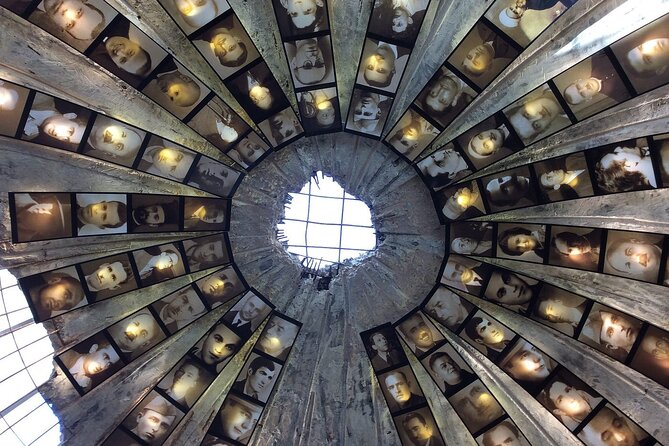
The tour then goes to Postbllok, or Checkpoint Monument, across from the government building. Allow about 30 minutes here. This is one of the most important stops because it addresses Albania’s communist isolation directly.
The memorial honors political prisoners who suffered under the regime. Its position on the main boulevard gives it extra force: this is not a remote museum piece hidden away from daily life. It sits in the middle of the capital, close to government offices and the city’s main public spaces.
This is also where the guide’s personal knowledge can make a major difference. The written description tells you what the memorial represents, but a good explanation can help you understand how political control shaped movement, speech, religion, and family life. Several guide accounts emphasize information about the communist period and personal or family connections to that era.
Postbllok is free, but it is not a light opening stop. If you prefer to begin with cafes and architecture, the serious subject may feel abrupt. I think that is part of its value. Tirana’s modern energy makes more sense once you understand what the city endured.
Blloku and the traces of Enver Hoxha
From Postbllok, the route moves into Blloku, a colorful district now filled with cafes, shops, and street art. The scheduled stop is about 10 minutes, followed by another 10 minutes near the former residence of communist leader Enver Hoxha.
Blloku offers one of Tirana’s clearest changes in atmosphere. During the communist period, it was restricted to members of the Albanian politburo. Today, it is one of the city’s most fashionable areas. The contrast is useful, but do not expect a long cafe break during the tour. Ten minutes is enough for orientation and explanation, not for settling in with a drink.
Passing Hoxha’s residence adds a physical point to the story. You see the district not just as a place for nightlife and shopping, but as an area once separated from the rest of the population. This is a good example of how the walk moves beyond a simple checklist of monuments.
If you want to return to Blloku for food or drinks, note the area during the tour and come back later. Lunch, drinks, and snacks are not included.
Orthodox Cathedral and the House of Leaves
The Resurrection of Christ Orthodox Cathedral receives about 15 minutes. Admission is not included, so you should be prepared for a possible separate ticket if you enter. The cathedral helps introduce Albania’s Orthodox Christian tradition and offers a useful counterpoint to the mosques and communist sites elsewhere on the route.
The next stop is the House of Leaves Museum of Secret Surveillance, also scheduled for about 15 minutes. Admission is not included here either. This former surveillance site is one of the most meaningful places on the walk for understanding how the communist state watched and controlled people.
Fifteen minutes is enough for a guided introduction, but it is not enough for a full museum visit. If you want to read displays carefully, you may need to return on your own and pay the entrance fee separately. That is an important planning point. The tour gives you the setting and context, while a second visit would let you explore the exhibits at your own speed.
These two stops also show the tour’s balance. It is not only about grand squares and attractive buildings. It includes places where Albania’s religious life and political repression can be discussed in concrete terms.
Something completely different:
- Hike Gamti Mountain with Bovilla lake view & canyon- From Tirana
★ 5.0 · 1,280 reviews - Berat city UNESCO tour, the Castle & Belshi lake- From Tirana
★ 5.0 · 804 reviews - Kruja castle, the old Bazaar & Sarisalltik- Departure from Tirana
★ 5.0 · 592 reviews - Albanian Night Show: Traditional Music, Dance & Dinner in Tirana
★ 5.0 · 431 reviews
Skanderbeg Square, the Clock Tower, and Et’hem Bej Mosque
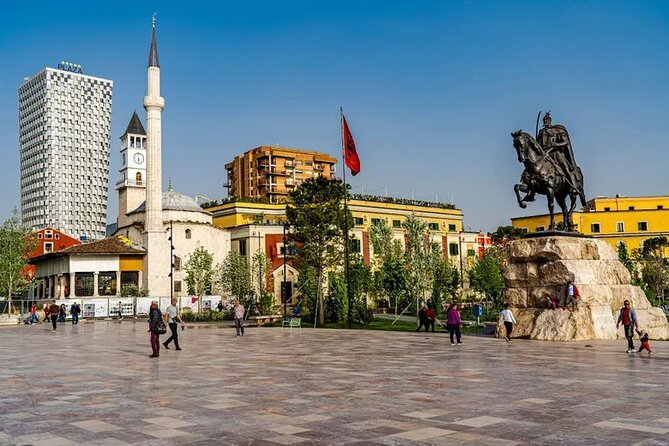
The walk then heads to Skanderbeg Square, the center of Tirana’s public life. The square takes about 15 minutes and is surrounded by major landmarks, including the National Museum, Bank of Albania, Opera Theatre, Skanderbeg Statue, Et’hem Bej Mosque, and cafes.
The square is named for Gjergj Kastrioti Skanderbeg, Albania’s national hero. His statue gives the city a strong national focus, while the surrounding buildings show the mix of political, cultural, and religious institutions that shape central Tirana.
The Clock Tower is another 15-minute stop. Admission is not included, so ask the guide about the current entrance arrangement if climbing or entering is important to you. Even without going inside, the tower helps you read the square and understand the historic center’s scale.
Et’hem Bej Mosque is also scheduled for 15 minutes, with free admission listed. It is one of the key Ottoman-era landmarks in the center. The mosque helps explain the long Muslim influence on Albanian society, while its position beside the Clock Tower and Skanderbeg Square makes it easy to connect with the city’s wider story.
The tour’s treatment of religious sites is one of its best features. Albania is home to Sunni and Bektashi Muslims, Orthodox Christians, and Catholics. The route does not present these communities as an abstract fact. You encounter their places of worship along the same central walk.
Dress and behavior should be respectful at religious sites. The tour data does not specify dress rules or opening conditions, so the guide remains your best source on what can be entered during your visit.
Tirana Castle and the city’s modern center
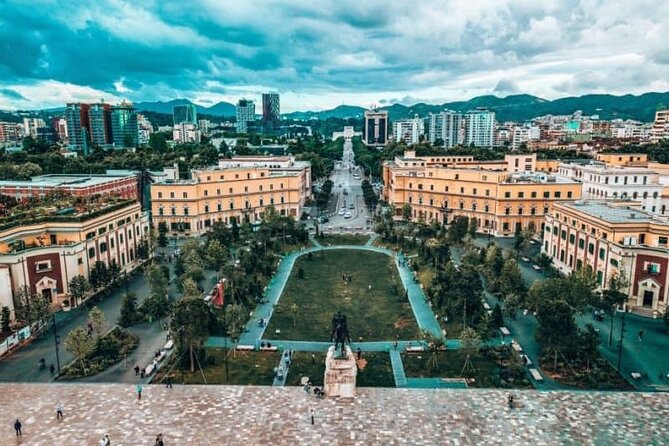
Tirana Castle receives about 15 minutes. The name can suggest a preserved fortress, but the current experience is a pedestrian street where traditional and modern elements meet. It is described as one of the city center’s more polished areas, with shops and places to eat.
This stop works best as a contrast to the political memorials and formal squares. Here, the focus turns toward contemporary Tirana and the way old city references are used in present-day commercial life. You may want to return later if you are looking for a meal or a drink, since the tour does not include refreshments.
The stop is short, so do not plan on a full meal during the walk. Instead, use it as a chance to note a place you may want to revisit after the tour.
Namazgah Mosque, the Pyramid, and Rinia Park
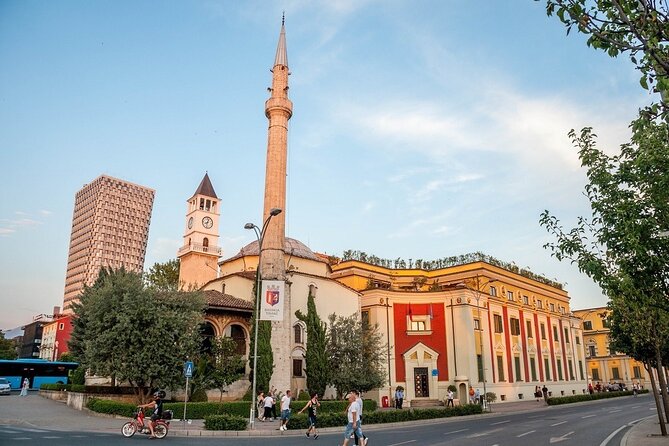
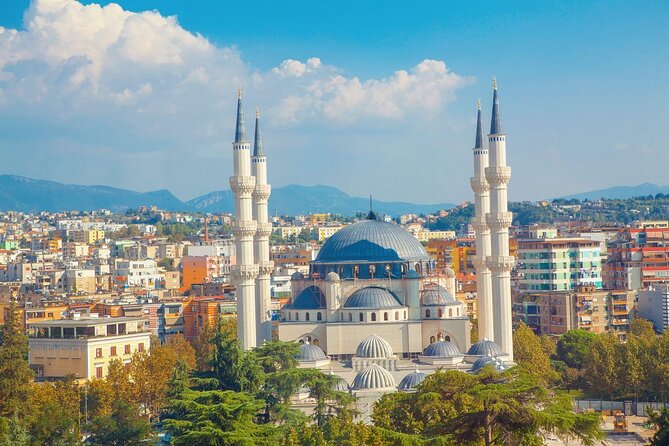
The next section brings together Albania’s religious diversity and its communist architectural legacy. The tour passes Namazgah Mosque, described as the largest mosque in the Balkans, along with the Orthodox Cathedral and Catholic St. Paul’s Cathedral. This section is scheduled for about 15 minutes.
The value here is comparison. You can see Muslim, Orthodox, and Catholic landmarks within the same central city experience. The guide can explain how religious communities continued, changed, or were restricted from the Ottoman era through communism and into current life.
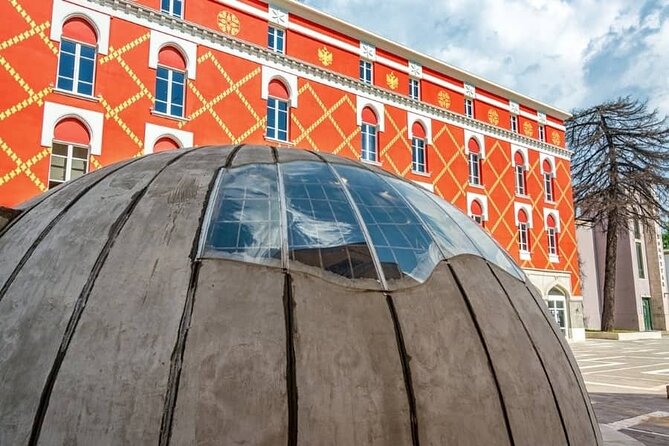
The tour is listed as ending at the Pyramid of Tirana, with about 10 minutes there. The Pyramid is one of the city’s most recognizable communist-era structures and gives the final part of the walk a strong architectural marker. It is a fitting place to think about how Albania has reworked symbols from its former regime.
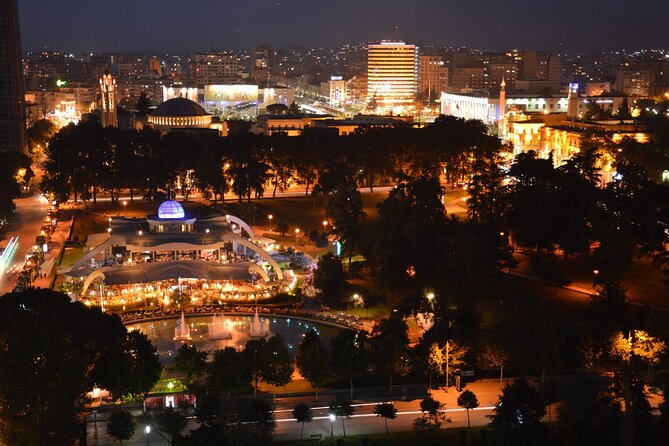
Rinia Park is also listed as a 10-minute stop. The supplied route information places it after the Pyramid, so you should confirm the exact final order with the operator. The tour summary says the activity ends back at the meeting point, while the itinerary names the Pyramid as the ending point and also includes Rinia Park. This is a small but useful detail to clarify, especially if you have a later reservation.
Group size, pace, and guide quality
The tour has a maximum of eight people. That is a real advantage for a history-focused walk. You can ask about communism, religion, or daily life without trying to catch a guide’s attention from the back of a crowd.
The guide quality appears to be the main reason to book. Markel is described as patient and kind, with one account noting that he waited for the group and kept the tour to two hours in hot weather. Another account praises his personal and family insights into Albanian life under communism and today.
Gjergj has been praised for speaking several languages and conducting the tour in French and English for the group present. Angelo is described as friendly and well informed about Tirana’s main sights and Albania’s political past. Guides can change, of course, but the experience places clear weight on local companions rather than a fixed audio script.
The route is offered in English. The French example shows that multilingual support may sometimes be possible, but you should not assume another language unless the operator confirms it.
What the $17.97 price includes
The fee includes a local companion and the walking tour. It does not include lunch, drinks, snacks, souvenirs, personal spending, or anything else not named in the inclusions.
Three listed attractions have admission not included: the Resurrection of Christ Orthodox Cathedral, House of Leaves, and Clock Tower. The route also lists free entry for Postbllok, Blloku, Skanderbeg Square, Et’hem Bej Mosque, Tirana Castle, Namazgah Mosque, the Pyramid, and Rinia Park.
That makes the price easy to understand. You receive a guided route through many central sights for less than the cost of a long paid attraction. The tradeoff is that the walk gives you brief visits rather than extended indoor time. If you want to study the House of Leaves in detail, plan a separate visit and add its ticket to your budget.
Tips are not required in Albania or the Balkans, but the operator recommends tipping for good service as an international custom. Treat that as optional, not as a hidden fee.
Who should book this walking tour?
I would choose this tour if you are visiting Tirana for the first time and want a solid orientation in one morning or afternoon. It suits people who enjoy asking questions, learning political context, and seeing how a city’s past affects its current streets.
It is also a good match for visitors with limited time. The route covers a lot of central Tirana without requiring transport between stops. The small group should help if you want a conversational experience instead of a lecture.
You may want another option if your priority is lengthy museum visits, restaurant time, or a slow architectural study. The itinerary gives most stops 10 to 15 minutes, so the tour keeps moving. Hot weather may also make the outdoor route tiring, though the two-hour version can help.
Should you book it?
Book it if you want clear historical orientation, a small group, and local conversation at a modest price. The strongest value comes from the guides’ explanations, especially around communism, religious diversity, and the changes in Blloku.
Before paying, confirm the final stopping point and ask which attractions are likely to be entered. If you understand that this is a guided overview rather than a series of full museum visits, it should give you a useful first map of Tirana and several ideas for places to revisit on your own.
FAQ
Where does the Tirana walking tour start?
It starts at the Choose Balkans Albania Tour Operator office, on the third floor of Tower 2 at the Twin Towers, Bulevardi Dëshmorët e Kombit, Tirana 1001.
Where does the tour end?
The activity information says it ends back at the meeting point. The route also lists the Pyramid of Tirana and Rinia Park near the end, so confirm the exact final stop with Choose Balkans.
How long does the walking tour last?
The tour lasts approximately two to three hours. One reported version took two hours, which can be useful in hot weather.
How much does the tour cost?
The listed price is $17.97 per person.
What language is the tour offered in?
The tour is offered in English. A guide has also conducted a tour in both French and English, but additional language availability should be confirmed.
How many people can join the tour?
The maximum group size is eight people.
Are attraction tickets included?
No. Admission is not included for the Resurrection of Christ Orthodox Cathedral, House of Leaves Museum of Secret Surveillance, and Clock Tower. Several outdoor and religious sites are listed with free admission.
Are food and drinks included?
No. Lunch, drinks, snacks, souvenirs, and personal spending are not included.
Can most people participate?
Yes. The activity information says most people can participate. Confirmation is provided when you book.
Can you cancel for a full refund?
Yes, if you cancel at least 24 hours before the experience start time. Cancellations or changes made less than 24 hours in advance are not refunded or accepted.
More History Tours in Tirana
- Tirana Walking Tour: History, Culture &Gems by a Passionate Guide
★ 5.0 · 52 reviews - Semi – Private Tour at Cape of Rodon; Hidden Beaches & History
★ 5.0 · 46 reviews - Berat Cultural Tour by 1001 Albanian Adventures
★ 5.0 · 26 reviews - Day Trip To Berat,UNESCO Heritage with Tirana Day Trips
★ 5.0 · 19 reviews
Just added in Tirana
- Wine Tasting day in Berat (Visit to the Berat Castle & Lunch included)★ 4.5 · 6 reviews
- From Tirana Wine Tasting & Food tour in Berat★ 5.0 · 5 reviews
- Visit Albania and Kosovo★ 5.0 · 2 reviews
- Bovilla and Kruja: Where History Meets Nature★ 5.0 · 2 reviews
- Virtual Reality Games and Experiences – Perfect place to drink and have fun!★ 5.0 · 2 reviews
- Visit Albania and Montenegro★ 5.0 · 1 review
- UNESCO heritage in Albania – 4 days★ 5.0 · 3 reviews
- Exclusive Qafshtama National Park Hiking Tour With Private Transfer★ 5.0 · 1 review
Historical Tours, compared.

Tirana Walking Tour: History, Culture &Gems by a Passionate Guide
Read our review →
Semi – Private Tour at Cape of Rodon; Hidden Beaches & History
Read our review →
Ancient City of Butrint, UNESCO World Heritage site – A Must
Read our review →
Day Trip To Berat,UNESCO Heritage with Tirana Day Trips
Read our review →
Private Full-Day Historical Day Tour in North Macedonia and Albania
Read our review →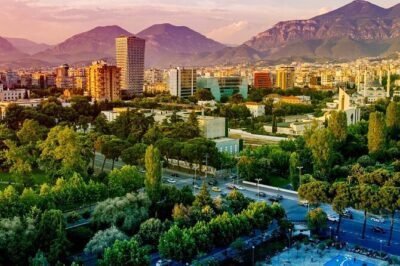
Browse the lists this tour appears in